Monday, August 29, 2011

In case you were wondering what happened to all that gold recently found in Kerala

A recent article from the UK Telegraph about the recent find of gold (£14 billion worth) in the Sri Padmanabhaswamy Temple:

Indian maharaja accused of stealing gold from £14 billion Hindu treasure trove

An Indian maharaja has been accused of stealing gold from what is believed to be the world's greatest treasure trove discovered in an ancient Hindu temple earlier this year.

Sri Padmanabhaswamy Temple in Trivandrum, South India Photo: ALAMY


By Dean Nelson, New Delhi
10:38PM BST 28 Aug 2011

The head of the Travancore royal family Maharaja Uthradam Thirunal Marthanda Varma regularly stole priceless jewellery and coins from the temple's treasure trove, which is estimated to be worth £14 billion, according to former temple employees and Kerala's former chief minister.

Archaeologists discovered gold figures, antique coins and jewels in a secret vault at Thiruvananthapuram's Lord Padmanabhaswamy Temple in southern India in July.

According to Kerala's former chief minister and current opposition leader V. S. Achuthanandan, the maharaja regularly removed gold coins from the temple during his morning prayers.

Several employees including temple security guards had reported the "thefts" to him, he said, and some of those who complained were removed from temple duties. He said he will now bring the allegations before India's Supreme Court and ask the temple authorities to explain their dismissals, he said.

"It is known public that Sree Padmanabha Swamy Temple has invaluable treasure. There were complaints that the assets of Sree Padmanabha Swamy temple were lost. Petitions were received alleging that ex-Army officers who tried to prevent theft of the temple assets were even terminated from the service," he said.

His allegations were dismissed as "baseless" by the temple's executive officer, V. K. Harikumar.

"He has no evidence to prove it. No former or current employee of the temple trust has ever made any complaints or allegations. There is no question of Royal family or for that matter anyone else entering vault B and taking away gold coins," he said.

"The Royal family is yet to decide on whether to file a defamation case against V. K. Achuthanandan," he added.

The allegation is the latest twist in the controversy over the discovery of the treasure trove.

T.P. Sundara Rajan, the man who successfully petitioned the courts to open the vaults and explore their secrets, was found dead within a week of it being opened.

His fight to examine the vaults went against the wishes of their custodian, the Maharaja of Travancore, and the temple's priests.

His death brought comparisons with the so-called 'Curse of the Pharoahs' blamed for the early demise of several explorers of Tutenkhamun's tomb in 1922.

Since Mr Rajan's death, Hindu priests warned that the families of those who try to open a second vault at the temple would face tragedy, death and the "fatal ire of snakes".

The dispute began earlier this year when a court ordered the management of the temple and control of its assets to be transferred from the Travancore royal family, which controls a trust which manages the temple's affairs, to the state. The court also ordered its assets, hidden inside a series of vaults, to be inspected and audited.

Priests believe the temple, built in 6AD, belongs to Lord Padmanabhaswamy, an incarnation of the Hindu God Lord Vishnu, and only he can open its vaults.

Some recent articles about Anna Hazare

Here are two articles from the "Sydney Morning Herald" & "The Telegraph" (UK) discussing recent events relating to Anna Hazare:

India hunger strike over as MPs yield on graft

Bibhudatta Pradhan
August 29, 2011

Anna Hazare waves as he accepts a letter on the agreement. Photo: AFP


ANNA Hazare, leader of an anti- corruption campaign in India, ended his hunger strike yesterday after MPs pledged a tougher law against graft.

Both houses of parliament had earlier passed a resolution agreeing ''in principle'' to the three conditions set by Mr Hazare, 74, who modelled his protest methods on those of Indian independence icon Mahatma Gandhi.

The move ends a political deadlock 12 days after the activist started his fast.
''It's only half a victory,'' Mr Hazare told supporters at the Ramlila fairground in the capital, Delhi, before saying he intended to end his fast yesterday. ''Total victory is yet to come.''

Supporters of Mr Hazare and cabinet members have sparred over a bill that activists say is crucial to deter corruption.

Civil society members, who said the government's version of the bill lacked teeth, wanted to push through their own, while the ruling Congress Party and others said parliamentary rules must be obeyed.

The public's confidence in the democratic process is ''rejuvenated'', said N. Bhaskara Rao, chairman of the Delhi-based Centre for Media Studies. ''Hopefully, we will see a stronger anti-corruption bill.''

Prime Minister Manmohan Singh's administration, which is embroiled in corruption allegations, is under pressure to tackle the problem three years before he seeks the endorsement of voters for a third consecutive five-year term.

The sale of phone permits in 2008, which the nation's auditor says was at below market prices and ''arbitrary'', sparked protests nationwide and led to the imprisonment of a minister, a lawmaker and many company officials.

Mr Hazare had called on parliament to start discussions on establishing ombudsmen in all the states, to make anti-graft laws more wide-ranging, and to prepare a ''citizens' charter'' to oversee ministries.

The demands, termed ''sticky issues'' by Mr Hazare's supporters, had prevented a resolution to the impasse.

In Delhi, people cheered and shouted slogans when he announced an end to his fast that evoked nationwide support.

The biggest demonstration in the capital on August 21 drew as many as 50,000 people.
Reclining at the Ramlila fair ground on cushions beneath a giant portrait of Gandhi, Mr Hazare, who has lost almost 7.5 kilograms since beginning his fast, said public support had given him energy.

While draft proposals for a corruption ombudsman have been presented to parliament on eight separate occasions since 1968, they have never been approved. The Comptroller and Auditor-General said last year that opaque rules allowed the government to sell airwaves in an ''unfair and inequitable manner,'' potentially costing the exchequer as much as $A29 billion.

The government's version of the ombudsman bill excludes oversight of a serving prime minister, judges, most bureaucrats and the actions of lawmakers in parliament.

The activists want the country's highest executive, judiciary and all bureaucrats covered, with sweeping powers to probe and prosecute.

BLOOMBERG

This article was found at: http://www.smh.com.au/world/india-hunger-strike-over-as-mps-yield-on-graft-20110828-1jgnh.html

-----------------------------------------------------------------------------------

Anna Hazare ends hunger strike as India concedes to his demands

The anti-corruption campaigner Anna Hazare ended his 12 day hunger strike on Sunday after the Indian prime minister accepted his demands for a powerful new watchdog to check graft.

Hazare supporters gather in their thousands to celebrate the end of his hunger strike, near the India Gate memorial in New Delhi Photo: AP


By Dean Nelson, New Delhi
10:21PM BST 28 Aug 2011

The veteran Gandhian activist announced his decision in tumultuous scenes at the Ramlila ground close to the walls of Old Delhi where thousands of supporters have gathered each day throughout his fast.

"This is your victory. This is the fruit of your work in the last 13 days … This movement has made it seem possible that we can build a corruption-free India," Mr Hazare told his supporters before being taken to hospital where his condition will monitored.

He launched his fast in protest at a government attempt to exempt the prime minister's office, MPs, and the judiciary from the scrutiny of the new ombudsman.
His India Against Corruption group has been transformed by his fast into a nationwide movement propelled by public anger at a number of bribery and malpractice scandals.

They include the inquiry into the allocation of mobile phone operator licences, the Adarsh housing scandal in Mumbai where apartments built for war heroes and widows were given instead to top generals, and the debacle over contracts for last year's Commonwealth Games.

India's former telecommunications minister, the daughter of the Congress Party's main coalition partner, and the Congress politician in charge of the Games are all now in jail. During his fast four MPs were charged with buying and selling votes to save the Congress government in a 2008 confidence vote.

Mr Hazare had been arrested and held in Delhi's Tihar Jail when he first tried to launch his protest earlier this month, but was released the following day after demonstrations throughout the country.

As his condition began to deteriorate last week – he had lost six kilograms and was suffering kidney problems – support grew throughout the country, and alarm spread throughout the government. Negotiations to end his hunger strike intensified on Thursday culminating in a parliamentary debate on Saturday.

Mr Hazare indicated he would end his hunger strike on Sunday after the parliament agreed to also bring the lower ranks of the bureaucracy under the new ombudsman, establish new watchdogs for every state government, and issue a new citizen's charter to set standards for public services. It is understood, the government has accepted the prime minister's office, MPs and judges will be monitored by the new watchdog, but no undertakings have been put in writing.

The fast officially ended on Sunday morning when two girls, one an 'untouchable' Dalit and the other a Muslim, brought him coconut water mixed with honey.

Mr Hazare conceded however that the government's concessions amounted to a "half-victory" and that the final shape of the Jan Lokpal bill which will create the new watchdog will be decided by the Indian parliament. His hunger strike, he said, had been suspended pending a 'full victory,' rather than abandoned.

The BJP opposition leader Sushma Swaraj said welcomed the concessions and the end of the hunger strike. "History has given us an opportunity, we should not miss it," she said.

Sunday, August 28, 2011

Some articles about the Caste Census in India

They are currently conducting a caste census here in India. Here are a few articles from the "Sydney Morning Herald" about it:

Census casts net wide as India wrestles with past Ben Doherty
August 27, 2011

The washerman Mp Kanaujia of the Dhobi caste irons clothes after taking part in the caste census. Photo: Kate Geraghty

..For MP Kanaujia, there is no escaping caste. It defines him, and has laid out his life's path. His caste is his profession, his name and, more broadly, his station in life.

Dhobi is a washer of clothes in Hindi. Kanaujia - the name itself is his subcaste - is of the dhobi caste, one who washes. And that is what he does, day-in day-out from his ramshackle humpy at the end of a row of modest government apartments in the northern Indian city of Chandigarh.

''My caste is who I am, we don't speak often about it, because everybody knows,'' he said.

Advertisement: Story continues below But it's relevant for the men who've come to visit today. For the first time in 80 years, India is undertaking the herculean task of a caste census.

To most Hindus, caste - a complex hereditary social hierarchy that involves four main orders [varnas] and thousands of sub-castes [jatis] - is the foundation of religious and social identity.

But independent India has never before asked its citizens to which caste they identify. The last time such a survey was undertaken was in 1931, when the British raj decided to count and label every subject.

Formally, the caste system has been abandoned under the Indian constitution but governments recognise it exists still. Since independence, efforts have been made to level the playing field for the downtrodden castes, particularly the lowest strata, known then as untouchables, now more commonly called dalits. Affirmative action programs reserve university places, government jobs, even seats in parliament for so-called backward castes.

So Kanaujia is happy to nominate his. ''I think it's a good idea. My daughter has just finished her schooling and if this census helps with the quotas for backwards castes, there might be more places for her to complete more education,'' he said.

Kanaujia has lived in his single-room lean-to, made from scavenged pieces of wood and a roof of tarpaulin held down by stones for 25 years, washing and ironing each day with his wife. ''I would like her [my daughter] to get a good government job,'' he says, pointing to the brick houses up the street. ''I want my daughter to have more opportunity.''

For millennia ''old India'' has been stratified along caste lines. It determined the clothes people wore, the food they ate [and with whom], the jobs they could do, and who they could marry. Many, especially rural Indians, still identify with their caste name: it ties them to a place and to a community.

But ''new India'' rails against such fatalist labels. Critics say a caste census will only entrench the social divisions the country is trying desperately to dissolve.

''I am troubled at making caste the central point of all public policies because this will damage the real fight in the society between the haves and have-nots, the rich and poor, irrespective of their religion and caste identities,'' the retired chief justice of the Delhi High Court and prime ministerial adviser Rajindar Sachar wrote.

Many of India's urban elite reject the idea of being tied to caste. To the middle class and those aspiring to it, education, career and address are the new social yardsticks.

It is in the cities - Mumbai, Delhi, Bangalore - where people are most expected to exercise their right not to nominate a caste.

Caste may be controversial - a just-released Bollywood movie, Aarakshan, or Reservation, which deals with the issue of quotas has been banned in three states - but to pretend it no longer matters is to ignore the realities of thousands of years of socialisation, and deeply ingrained mores.

Matrimonial ads in Sunday newspapers are still listed by caste - Aggarwal seeks Aggarwal - and to marry out of one's caste is still a scandalous offence in many families.

The government, reluctantly forced into the survey by backward class MPs, say that if benefits are to be handed out on the basis of caste, the country needs to know how many of each there are. Up to 49.5 per cent of government jobs and university places are quarantined for members of India's scheduled castes, scheduled tribes and other backward classes. But the 2011 caste census will also be a measure of India's burgeoning, but uneven, economic development.

About 455 million people live on less than $1.25 a day. Half the world's hungry live in this country. The government wants a firm figure on just how many of its citizens live below the poverty line.

Every household is asked for a range of economic data, from work and income details, to how many rooms the house has, it has an air-conditioner, a mobile phone, a car or a washing machine. It also notes house building materials and access to electricity and to running water.

The task of counting every single person in India - about 1218 million in last year's population census - is a mammoth undertaking. More than 2 million ''enumerators'' will spend three months finding every family in the country. The cost will top 35 billion rupees ($725 million).

But the debate over caste is a wrestle between old India and new. In the rural villages caste still dominates. But a street in Chandigarh's Sector 7C demonstrates how urbanisation has worn down ancient convention. At four consecutive houses live families of differing castes, from the highest, Brahmins, to dalits. Reshmi is a chamar, a dalit caste. Her neighbours are Brahmins. Despite her family's status, her husband has a government job.

''Some people might not want to say their caste, they think there is no more caste in India, but everybody knows it, and the government should help the lower castes with education and jobs, to make a better life for themselves.

''Everybody knows our caste by what we eat and what we wear. I am proud to say to my caste, I have nothing to hide.''

This article was found at: http://www.smh.com.au/world/census-casts-net-wide-as-india-wrestles-with-past-20110826-1jeea.html

------------------------------------------------------------------------------------
Census controversy shows caste politics still counts in India
MATT WADE IN NOIDA, INDIA
May 15, 2010

Glory... Kumari Mayawati at a ceremony in New Delhi in 2007 in front of statues of herself and the Dalit heroes B.R. Ambedkar and Kanshi Ram. Photo: AFP

They were once pushed to the margins, condemned to the filthiest jobs. But for many Dalits - previously the Untouchables of the Hindu caste system - times have changed.

Perhaps no one symbolises this better than the ''Dalit Queen'', Kumari Mayawati, who has been Chief Minister of India's most populous state, Uttar Pradesh, for three years.

A hallmark of Mayawati's reign has been her passion for building statues to honour Dalit political leaders, herself included. The latest - a row of towering lower-caste heroes covered from head to toe in blue material and built at a cost of more than $80 million - stands on the banks of the River Yamuna at Noida, a booming high-tech business hub 20 kilometres south-east of New Delhi.

Advertisement: Story continues below It is estimated Mayawati has spent at least $300 million on monuments to Dalit leaders in Uttar Pradesh, an impoverished state of 180 million. There are about 20,000 statues of the great Dalit leader B. R. Ambedkar dotted across the state, most of them commissioned by Mayawati.

She rejects criticism of her statue-building frenzy, saying the statues are an inspiration for low-caste people who have been repressed and excluded from power for a millennium.

Badri Narayan Tiwari, a specialist in caste politics at the G. B. Pant Institute of Social Sciences, in Allahabad, says the statues are a strategy to build ''respect'' for Dalit caste identity through visuals and stories.

The influence of caste in India was underscored again last week when the Finance Minister, Pranab Mukherjee, announced the government would require Hindus to record their caste in the colossal 10-yearly national census now under way. The last time caste numbers were counted was in 1931, when the British ruled the subcontinent.

The governing Congress Party - which has resisted counting caste in the census for decades - has changed its position in an apparent effort to please the caste-based parties that now wield great influence in national and regional politics.

The success of Mayawati, who has risen to power in the Hindi heartland with the passionate support of Dalits, illustrates the importance caste has in modern Indian politics. Her main rival for power in Uttar Pradesh is a party that draws its support from a large and powerful caste called the Yadavs.

''Caste has been there in Indian politics for a very long time but it's becoming more explicit now,'' says a Delhi University political analyst, Mahesh Rangarajan.

Tiwari says government attempts to breakdown caste barriers have helped eradicate social disadvantage but, at the same time, reinforced the role of caste in politics.

''The Indian state, which is working to dilute the caste system, is also strengthening caste identity,'' he says.

Caste assigns Hindus a place in the social hierarchy based on hereditary groups originally formed around occupations. . The system has four broad groups or varnas: Brahmins (priests), Kshatriyas (warriors), Vaishyas (merchants and farmers) and Sudras (manual workers). Each caste stratum has a complex web of ''subcastes'' - about 6000 in all - that vary across regions.

The title Dalit describes a cluster of subcastes at the very bottom of the hierarchy. Mahatma Gandhi challenged the poor treatment of this group and called them ''Harijans'', children of God.

Discrimination on the basis of caste is banned by the Indian constitution and low castes benefit from social programs and affirmative action. This includes quotas for government jobs, university courses and even parliamentary seats.

Even so, caste prejudice remains pervasive despite rapid social and economic change. A recent study found that having a low-caste surname significantly reduced the chances of being called for a job interview.

The widespread aversion to inter-caste marriage is highlighted each Sunday, when newspapers carry pages of advertisements by parents seeking an appropriate spouse for their son or daughter. Most of these ''matrimonials'' are grouped by caste and subcaste and many make it clear that those lower in the hierarchy need not respond.

The decision to count caste in the census has triggered vigorous debate about the role of caste in politics and society.

Supporters argue a proper count will give reliable data on groups getting state benefits and help the government target affirmative action measures better. Modern estimates of caste numbers in India rely on the last official tally, now 80 years out of date.

However, critics warn the count could inflame social tensions and further entrench caste politics. It may also open a Pandora's box of political demands from powerful caste groups emboldened by official figures. The inclusion of the caste question in the census has been pushed by political leaders from the so-called ''other backward castes'', in the hope they can win more government benefits for their constituents.

''There are genuine apprehensions that this could lead to more agitation and conflict,'' says Rangarajan.

Pratap Bhanu Mehta, the president of the Centre for Policy Research, in Delhi, believes counting caste in the census trashes fundamental principles of Indian democracy and will make it more difficult to rid the country of ancient prejudices and hierarchies.

''At one stroke, it trivialises all that modern India has stood for,'' he wrote in the Indian Express, ''and condemns it to the tyranny of an insidious kind of identity politics.''


This article was found at: http://www.smh.com.au/world/census-controversy-shows-caste-politics-still-counts-in-india-20100514-v4e0.html

A Day on the Thai-Burma Railway

Tania & I did a day trip out to the Thai-Burma railway. We started off with a visit to the JEATH War museum, before taking a boat ride up to the River Kwai Bridge, then a short ride on the train up the Thai-Bruma railway before finishing the day at the POW cemetery at Kanchanaburi.

A bit of a history lesson:

The Thai-Burma Railway (also known as the Death Railway) was a 415 km stretch of railway between Bangkok and Rangoon built during the Second World War.

A map detailnig the route of the railway


Forced labour was used to build the line with about 180,000 Asian labourers & 60,000 Allied POWs involved. Of these, some 90,000 Asian labourers & 16,000 Allied POWs died as a direct result of the project. The dead POWs included 6,318 British personnel, 2,815 Australians, 2,490 Dutch, about 356 Americans and a smaller number of Canadians and New Zealanders.

Only a portion of the original railway is still in use (about 130 km) & that includes the “Bridge over the River Kwai”. The train now only goes as far as the town of Nam Tok (18km from the notorious “Hellfire Pass”). Large parts of the original track are now submerged as a result of the Vajiralongkorn Dam project.

Part of the route is now a walking trail (about 8km), including approximately a 4km section near “Hellfire Pass”.

Bridge over the River Kwai

There were actually two bridges built (one a wooden bridge & the second, a more permanent stone structure). Both were destroyed in air strikes towards the end of the Second World War. The stone structure was rebuilt & the rail line is still in use today.

Here’s something you might not know.....

In 1957, the movie “Bridge over the River Kwai” was released. This caused a large influx of tourists to Thailand to see the bridge.

There was a slight problem however.....the bridge was actually over the river “Mae Klong”. The name “Kwai” didn’t exist at that time. So.....in a brilliant marketing move in 1960, the Thai authorities changed the name of the river to “Khwae Yai” or “Kwai” in English. Now they could say there was a bridge over the River Kwai

On the river, heading up to the bridge

The Bridge over the River Kwai: the rounded spans are the original part of the original World War 2 structure while the rectangular spans are post-war repairs

Three trains a day run up the line & back


Train ride up the railway

It was quite a surreal experience being dropped off at a platform in the middle of nowhere, waiting for a train to take us part of the way up the Thai-Burma railway. Every time I looked at the line, I couldn’t help but think that tens of thousands of men died making this line that we are now riding on.


On the train heading up the line

On the train heading up the line


Hellfire Pass

Looking at it & the surrounding region now, it’s hard to imagine the appalling conditions the POWs & Asian labourers worked under to cut the largest & tallest (about 25m) rock cutting on the railway. These conditions included: a lack of proper construction tools, a remote location, lack of proper medical supplies, disease (including cholera & dysentery), starvation, exhaustion and savage beatings by the Japanese & Korean guards.

Construction of the cutting (also known as the Konyu Cutting) commenced on 25 April 1943 (ANZAC Day). Alot of the excavation was done by hand; using hammers, steel tap drills, explosives, pinch bars, picks, shovels & a wide hoe (called chunkels). Air compressors and jack hammers were used at one point. The bulk of the waste material was removed by hand, using cane baskets and rice sacks slung on two poles.

In order to complete the cutting on schedule, for a period of six weeks leading up to its completion in mid August, prisoners were forced to work 12 to 18 hour shifts around the clock, without a rest day. This section of the Thai- Burma Railway cost the lives of at least 700 Allied POWs, including 69 beaten to death by Japanese engineers or Korean guards.

Hellfire Pass was so called because the sight of emaciated prisoners labouring at night by torchlight was said to resemble a scene from Hell.

A wartime photo of the completed Hellfire Pass

It's hard to imagine such a beautiful place being a scene of such unimagineable horror


This was all cut out (mainly) by hand - can you imagine it ??


Kanchanaburi War Cemetery

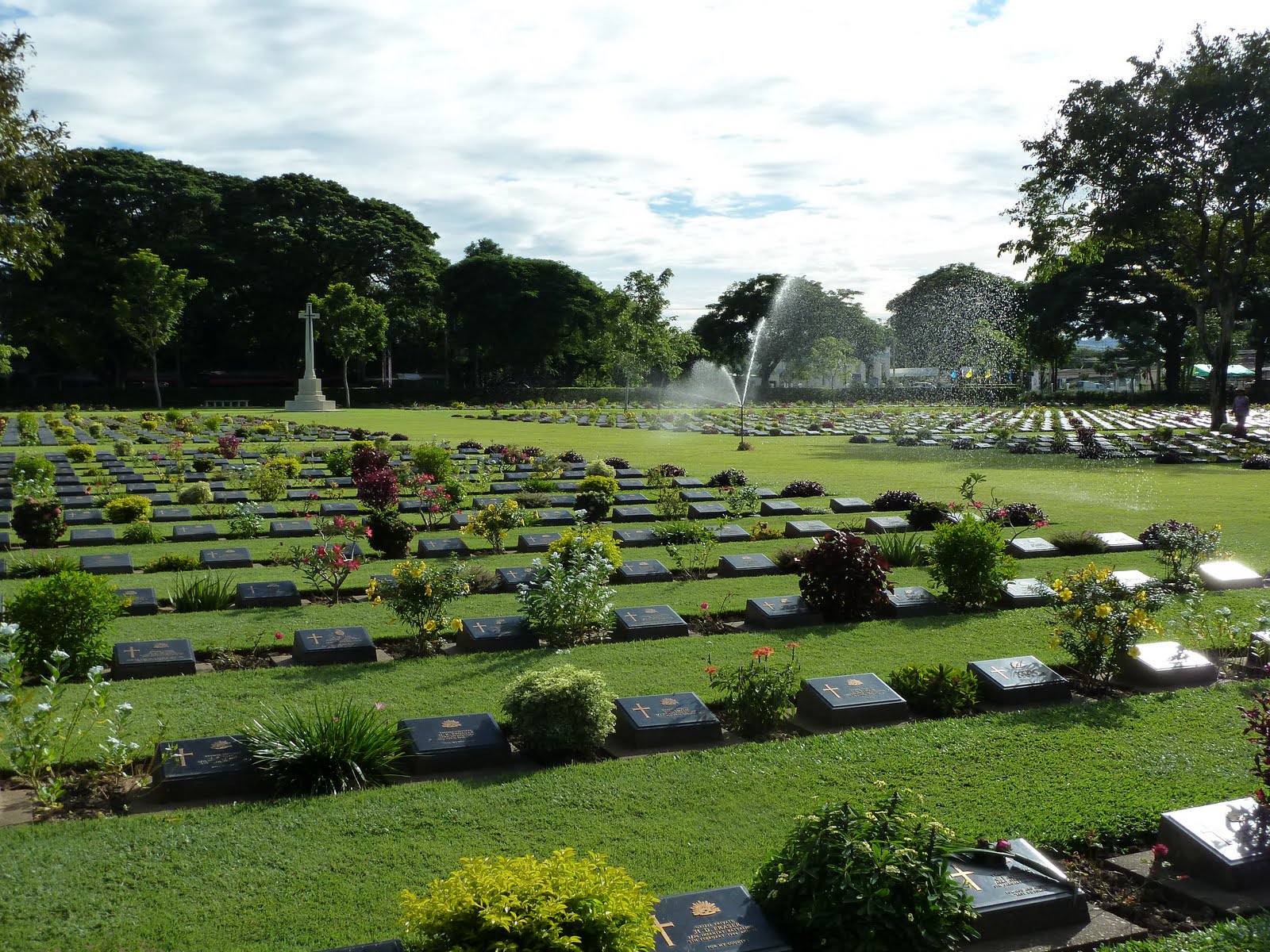
Our day trip finished with a visit to the main POW cemetery (immaculately maintained by the folks at the Commonwealth War Graves Commission) in the city of Kanchanaburi. Here, 6,982 POWs are buried, mostly British, Australian, Dutch and Canadians. It was quite a moving experience walking amongst the headstones, looking at where these men came from & how old they were when they died: most seemed to have died in their early twenties.

We met the curator Rod Beattie, who was there tending to the graves. He is a very nice bloke who took the time to talk to us about the cemetery & efforts by the Commonwealth War Graves Commission in the region. He was heavily involved in the clearing of the jungle around & up from Hellfire Pass. Details of his efforts & those of other volunteers to set up memorials in the area can be found at this link: http://www.btrma.org.au/articles/Hellfire-pass.htm


A visit to Ayutthaya – the old Thai capital

We went on a day trip to the old city of Ayutthaya. Ayutthaya was founded by the Thai King Ramathibodi I in 1350 and was the capital of the country until its destruction by the Burmese army in 1767.

Some background: in 1765, a 40,000-strong Burmese army invaded the territories of Ayutthaya from the north and west. After a 14 months' siege, the city of Ayutthaya capitulated and was razed in April 1767. Its art treasures, the libraries containing its literature, and the archives housing its historic records were almost totally destroyed, and the Burmese brought the Ayutthaya Kingdom to ruin. We were told by our guide that the complex contained a solid gold standing Buddha statue in one of the temples that the Burmese then melted down so as to take the gold back to Burma.

The complex contained a significant number of Buddha statues, which were destroyed (hacked to pieces by the Burmese). The Thai government has made an effort to restore the statues but it really is too big a task. Some statues, however, have been restored & can give you a sense of what this place must’ve looked like at the peak of its power.

It was after the Burmese left & Thai rule was restored that the capital was then moved to Bangkok.

One of the more famous things to see here is the detached head from a statue embedded into the roots of a banyan tree. Over the years, the roots have grown around the head & at some point in the future, will cover it up completely.

There is still alot of emotion about the sacking of the complex which may go some way to explaining the tension between the two countries.


The reclining Buddha – Wat Pho Temple

Near to the Royal Palace, at the Wat Pho temple complex is a 46m long and 15 m high statue of Buddha in an unusual reclining position: unusual in that most of the statues of Buddha you see, he is in the “Taking the Earth to Witness” position (left hand in lap, right hand touches ground) or the “Meditating” position (both hands in lap, palms up, right hand on top).

The reclining position represents the passing of the Buddha into nirvana.

This statue is huge & quite a sight. Even more amazing is the feet of the statue as they are engraved with mother-of-pearl decorations.


A visit to the Royal Palace – Bangkok

Upon our arrival in Bangkok & once we were checked in to the hotel, we made straight for the Royal Palace (in the process....getting ripped off in a boat ride up the river). We made it just before the last tickets were sold.

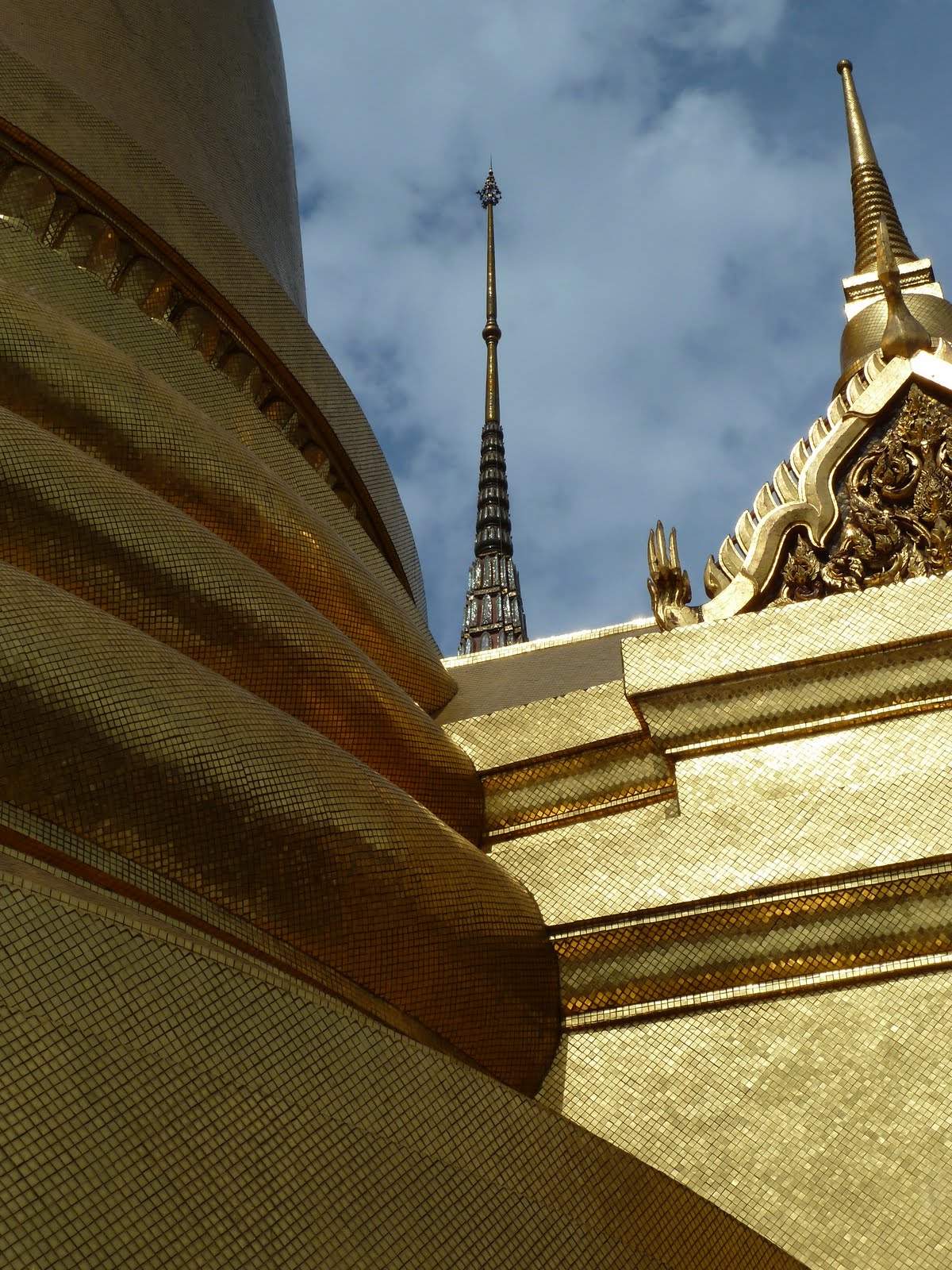
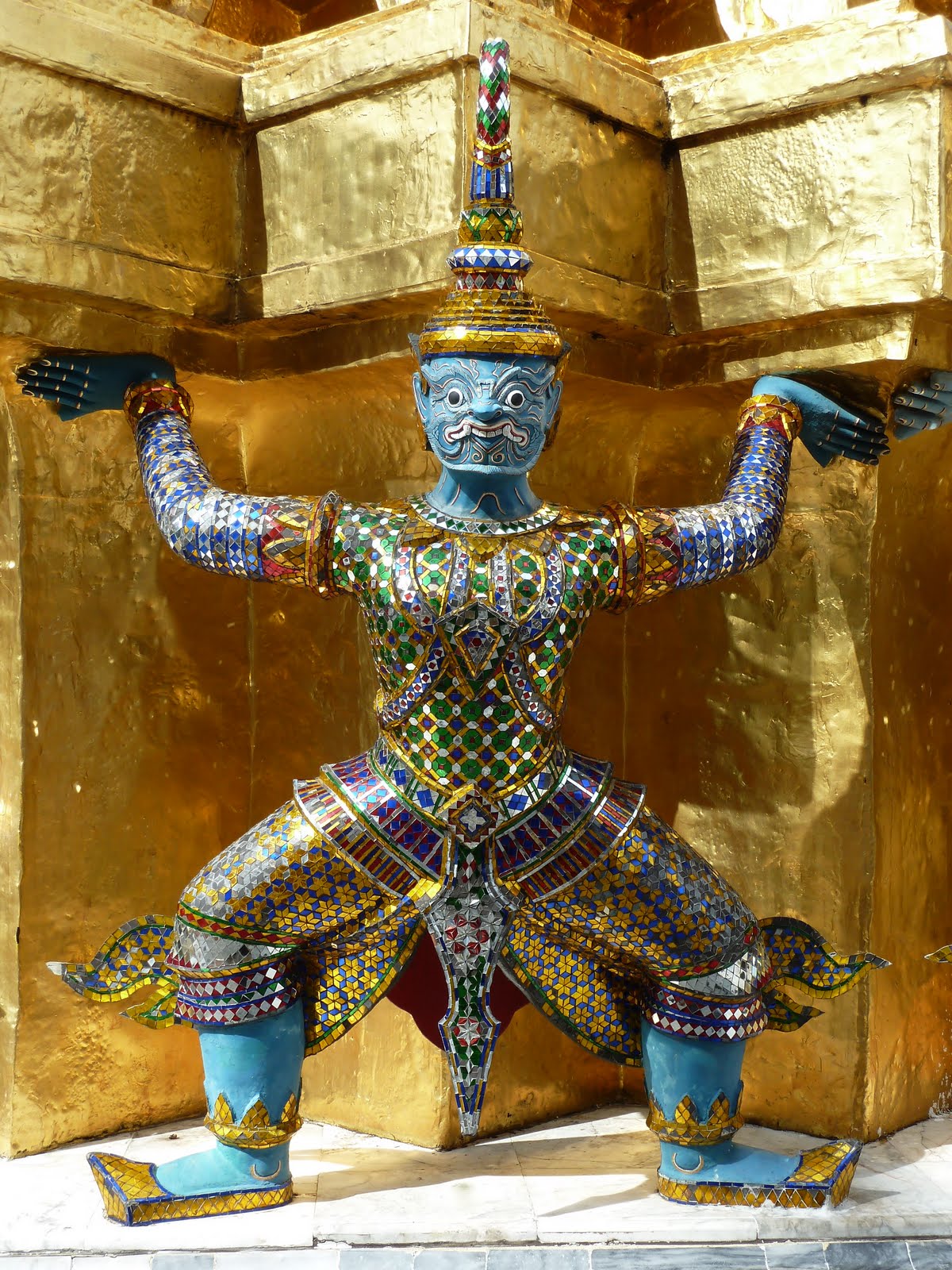
It’s an amazing place with outstanding architecture, statues & temples. Here’s a collection of photos: