There was an earthquake in Delhi last night at about 11.30pm.
It was a 4.2 on the Richter scale....downgraded from an initial analysis of 6.6.
I was drifting off to sleep at the time when I heard a “noise”...I can’t describe it any other way (some people said they heard what sounded like an airplane landing/crashing). Then, the entire apartment starts swaying for what seemed only a few seconds. Other people have said it lasted about 10 seconds & the movement was up & down.
I said to Tania: “What the f*** was that ??”. She said “an earthquake” & then promptly went back to her deep sleep (I hate it how she can do that so easily).
It was my first experience of an earthquake.
Everyone was talking about it at the High Commission this morning.
Thursday, September 8, 2011

Wednesday, September 7, 2011
A farewell for Owen
On Sunday, Tania & I hosted a farewell for one of her colleagues. Owen is a lovely bloke from Ireland who is heading home to get married & then is off to China for a posting.
We're going to miss his witty remarks on things he knows nothing about...and gets caught out on it !!
We'll miss ya Owen !!
 How's this for a dodgy lot
 How's this for a not-so-dodgy lot
 Who's that lovely person ??
 Food's up !!
 Tucking into the food
 Dessert anyone ??
We're going to miss his witty remarks on things he knows nothing about...and gets caught out on it !!
We'll miss ya Owen !!
 How's this for a dodgy lot
  How's this for a not-so-dodgy lot
 Who's that lovely person ??
 Food's up !!
 Tucking into the food
 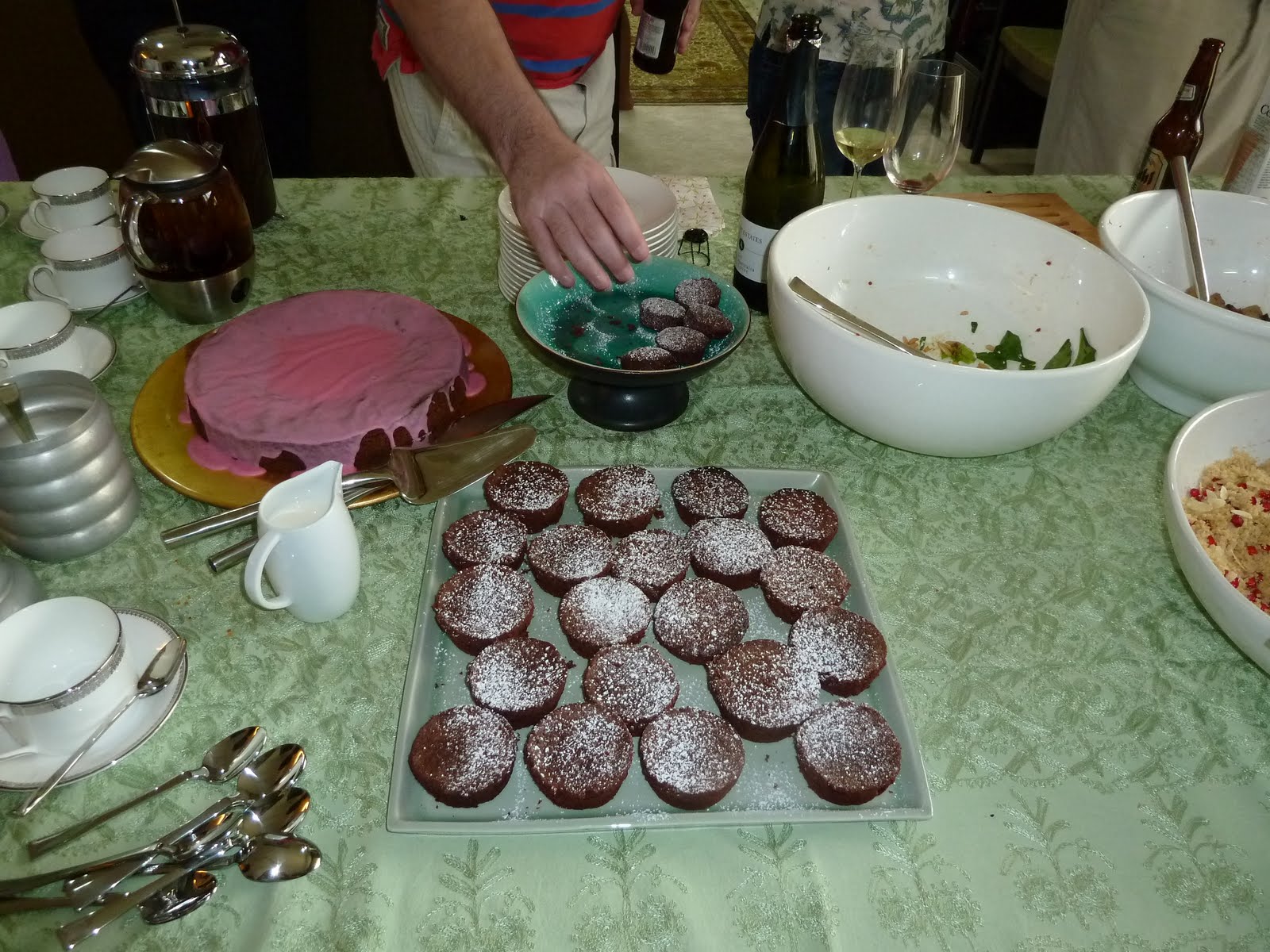 Dessert anyone ??
A collection of film photos from the Thailand trip
Yep...that's right !! You read it correctly. I'm one of those old-fashioned types who still use a film camera. The anticipation of the wait to see how your photos turn out is something I really enjoy. Trying to get your hands on film is proving to be an adventure in itself.
The looks you get from the folks when you ask for film is priceless. Here in India it's not so much of a problem as film seems to be readily available. I try to hoard whatever I get my hands on, especially when I'm overseas from India.
But....back to the photos.....enjoy:
 The Royal Palace - Bangkok


 The detail of the Mother-of-Pearl feet of the Reclining Buddha (Wat Pho)
 Destroyed Buddhas (Ayutthaya)
 Destroyed Buddha (Ayutthaya)
 Destoyed Buddha - detail
 Destroyed Buddha - detail
 Wild dog - getting down & sleepy (Ayutthaya)

 Elephant ride (Ayuttaya)
 Coming under the Bridge Over the River Kwai
 Watching the train cross the River Kwai - from the comfort of a bar
 Thai-Burma Railway
 Railway workers getting around - Thai-Burma Railway
 Riding the train
 Hellfire Pass
 Hellfire Pass from the highest point

The looks you get from the folks when you ask for film is priceless. Here in India it's not so much of a problem as film seems to be readily available. I try to hoard whatever I get my hands on, especially when I'm overseas from India.
But....back to the photos.....enjoy:
 The Royal Palace - Bangkok

 The detail of the Mother-of-Pearl feet of the Reclining Buddha (Wat Pho)
 Destroyed Buddhas (Ayutthaya)
 Destroyed Buddha (Ayutthaya)
 Destoyed Buddha - detail
 Destroyed Buddha - detail
 Wild dog - getting down & sleepy (Ayutthaya)
 Elephant ride (Ayuttaya)
 Coming under the Bridge Over the River Kwai
 Watching the train cross the River Kwai - from the comfort of a bar
 Thai-Burma Railway
 Railway workers getting around - Thai-Burma Railway
 Riding the train
 Hellfire Pass
 Hellfire Pass from the highest point
Tuesday, September 6, 2011
An article on rat catchers in India
This article was from the "Los Angeles Times" website:
latimes.com
COLUMN ONE
India's night rat killers: Hunting shadows that scurry
In Mumbai, stalking rats with a metal-tipped pole is a coveted job thanks to the steady pay. But the squeamish need not apply.
By Mark Magnier, Los Angeles Times
9:21 PM PDT, September 5, 2011
Reporting from Mumbai, India
 Mahesh Suresh Kamble, 20, is one of 33 night rat killers in Mumbai, India. He uses a metal-tipped pole to kill the rodents and has a quota of 30 per shift. (Mark Magnier, Los Angeles Times / September 6, 2011)
This city of 20 million people, the frenetic embodiment of India's energy, ambition and chaos, doesn't do quiet very well, even as it pauses for a few hours after midnight to rejuvenate. Tonight, monsoon rains from the Arabian Sea are forcing its thousands of street dwellers to retreat to dank hallways and dimly lit underpasses.
Mahesh Suresh Kamble and his co-worker, Sangpal Sitaram Bachate, wait for the rain to ease before heading to a complex of four-story apartments in the heart of the city, aware that their prey prefers indoor comfort in such weather.
The buildings, a few blocks from Mumbai's posh Queen's Necklace shoreline, are decrepit, their cornerstones chipped. The friends wade through butter wrappers and rotting onions tossed from windows above. It isn't long before they find what they're looking for: dozens of rats, scurrying along the walls, skulking behind parked bikes, crouched under newspapers.
The pair, assigned to "C Ward" in the old city, soon separate. As Bachate heads around a corner, Kamble enters a narrow alley and calmly approaches an 8-inch rodent, shining a flashlight into its eyes. The animal is blinded just long enough for Kamble to whack it in the head with his metal-tipped pole.
His blows are usually fatal. But this time he doesn't land a clean strike and the injured rat leaps into the air like a miniature circus performer. This job doesn't reward the squeamish. Kamble grabs the animal by the tail and finishes it off by slamming its head twice against the concrete sidewalk.
All in an evening's work for the 33 night rat killers employed by the Mumbai government under a system dating to the days of the British Empire, with the archaic equipment and tradition-bound requirements to prove it.
Kamble, 20, and Bachate, 27, beat out hundreds of other applicants for the job, some of whom had college degrees. Candidates must be 18 to 30 years old, have at least a 10th-grade education, be able to lift 110 pounds and pass a written exam and a video review of their rodent-killing skills.
After all that, a dozen finalists are taken to a field to see who kills the most rats in 15 minutes. Kamble and Bachate trained weeks for this challenge. Both bagged around 20, the best of the lot.
Six days a week, the city's night rat killers — NRKs in acronym-happy India — fan out from midnight till dawn to satisfy their individual quota of 30 fresh corpses per shift. Each has two nights to make up any shortfall: 90 in three days, or they don't get paid.
Oversized ledgers maintained by pest-control bureaucrats show that 214,848 rats met an untimely end in Mumbai between January and July of this year. Two-thirds were done in by the night killers, the rest by traps and poison. To put that success in perspective, consider that a single rat couple can give rise to 20 million offspring in three years, under ideal procreative conditions.
Those who administer the system from the comfort of their desks say details on its origins and evolution are all but lost to bureaucratic history. Nor can they explain why such exacting educational and fitness requirements are needed to thump a rodent with a stick.
The fastidiousness may stem in part from the subcontinent's history of devastating outbreaks of bubonic plague, an infection borne by the fleas of rodents. A sample of the daily rat haul is combed for fleas, which are tested for plague. Mumbai's last epidemic was in 1896, although several dozen people died in a 1994 outbreak several hundred miles to the north.
Mumbai, with Asia's largest slum and a port where cargo and furry stowaways from around the world are disgorged, is an ideal breeding — and hunting — ground for rats.
"We don't have a special rat census," city spokesman Ganesh Puranik says. "But I think we must have the most in the world. Rats don't think about family planning."
After conking a rat senseless, Kamble grabs its limp body between his toes and flings it onto open pavement, distant enough from walls and burrows that it won't be able to slink away if it suddenly recovers. Then he collects his kills in a plastic bag.
Kamble has honed his craft over time, stalking rats barefoot so they won't hear him, perfecting an overhead swing with his trusty pole. Bachate wears sandals and prefers a side-arm motion.
Other rat killers claim they can hear, even smell, their adversaries in the dark.
Kamble says he picked up tricks from older rat catchers, including which markets or dumpsters offer the best hunting and how to craft the best stick. He proudly shows off his creation, a bamboo rod 6 feet long with a nasty hook-shaped piece of metal on its business end.
Stick men are relatively rare even in India. Most cities here rely on traps, cats, poisons, fumigation and glue strips.
But the cudgel method is "brutal and simple," says Amrit Suryavanshi, head pest-control officer for C Ward.
It's also efficient. Traps get stolen. Poison makes children sick. Glue strips leave rats suffering for days.
The rat catchers say they haven't heard much from animal rights groups, although bystanders sometimes interfere during the annual festival of Ganesh, the Hindu elephant god, who is traditionally depicted riding a rat.
Kamble says he's had pangs of conscience, given the Hindu belief that a person could be reborn as an animal. (A temple in northeastern Rajasthan state worships rats as reincarnated storytellers.) But he reasons that he's doing God's work by eliminating disease carriers.
Suryavanshi believes Mumbai's rich classes could learn a lot from Kamble and Bachate. "They're not afraid to work hard, no matter how unpleasant it is, to safeguard the community," he says.
Another motivation, Kamble and Bachate say on a break from their killing spree, is the $175 a month income, provided they meet their quotas, and the chance after several years of rat catching to land a regular city job.
That sort of upward mobility is a fantasy made real for the likes of Kamble and Bachate, whose families migrated to Mumbai from subsistence villages in the 1980s.
Kamble is his family's only breadwinner. Among his responsibilities (he's still single) is saving for his younger sisters' dowries, often an Indian family's biggest expense.
Bachate works in construction during the day to supplement his rat-killing earnings.
"I don't get much sleep," he says. "Life's long and you must work hard."
At 27, it's time for him to think about marriage, which usually is arranged in India.
"I've been introduced to a girl, and her parents think a rat catcher in the family is great," Bachate says before heading into the darkness, his rat bag over his shoulder. "In fact, with this job I'm a bit of a catch."
mark.magnier@latimes.com
Copyright © 2011, Los Angeles Times
latimes.com
COLUMN ONE
India's night rat killers: Hunting shadows that scurry
In Mumbai, stalking rats with a metal-tipped pole is a coveted job thanks to the steady pay. But the squeamish need not apply.
By Mark Magnier, Los Angeles Times
9:21 PM PDT, September 5, 2011
Reporting from Mumbai, India
 Mahesh Suresh Kamble, 20, is one of 33 night rat killers in Mumbai, India. He uses a metal-tipped pole to kill the rodents and has a quota of 30 per shift. (Mark Magnier, Los Angeles Times / September 6, 2011)
This city of 20 million people, the frenetic embodiment of India's energy, ambition and chaos, doesn't do quiet very well, even as it pauses for a few hours after midnight to rejuvenate. Tonight, monsoon rains from the Arabian Sea are forcing its thousands of street dwellers to retreat to dank hallways and dimly lit underpasses.
Mahesh Suresh Kamble and his co-worker, Sangpal Sitaram Bachate, wait for the rain to ease before heading to a complex of four-story apartments in the heart of the city, aware that their prey prefers indoor comfort in such weather.
The buildings, a few blocks from Mumbai's posh Queen's Necklace shoreline, are decrepit, their cornerstones chipped. The friends wade through butter wrappers and rotting onions tossed from windows above. It isn't long before they find what they're looking for: dozens of rats, scurrying along the walls, skulking behind parked bikes, crouched under newspapers.
The pair, assigned to "C Ward" in the old city, soon separate. As Bachate heads around a corner, Kamble enters a narrow alley and calmly approaches an 8-inch rodent, shining a flashlight into its eyes. The animal is blinded just long enough for Kamble to whack it in the head with his metal-tipped pole.
His blows are usually fatal. But this time he doesn't land a clean strike and the injured rat leaps into the air like a miniature circus performer. This job doesn't reward the squeamish. Kamble grabs the animal by the tail and finishes it off by slamming its head twice against the concrete sidewalk.
All in an evening's work for the 33 night rat killers employed by the Mumbai government under a system dating to the days of the British Empire, with the archaic equipment and tradition-bound requirements to prove it.
Kamble, 20, and Bachate, 27, beat out hundreds of other applicants for the job, some of whom had college degrees. Candidates must be 18 to 30 years old, have at least a 10th-grade education, be able to lift 110 pounds and pass a written exam and a video review of their rodent-killing skills.
After all that, a dozen finalists are taken to a field to see who kills the most rats in 15 minutes. Kamble and Bachate trained weeks for this challenge. Both bagged around 20, the best of the lot.
Six days a week, the city's night rat killers — NRKs in acronym-happy India — fan out from midnight till dawn to satisfy their individual quota of 30 fresh corpses per shift. Each has two nights to make up any shortfall: 90 in three days, or they don't get paid.
Oversized ledgers maintained by pest-control bureaucrats show that 214,848 rats met an untimely end in Mumbai between January and July of this year. Two-thirds were done in by the night killers, the rest by traps and poison. To put that success in perspective, consider that a single rat couple can give rise to 20 million offspring in three years, under ideal procreative conditions.
Those who administer the system from the comfort of their desks say details on its origins and evolution are all but lost to bureaucratic history. Nor can they explain why such exacting educational and fitness requirements are needed to thump a rodent with a stick.
The fastidiousness may stem in part from the subcontinent's history of devastating outbreaks of bubonic plague, an infection borne by the fleas of rodents. A sample of the daily rat haul is combed for fleas, which are tested for plague. Mumbai's last epidemic was in 1896, although several dozen people died in a 1994 outbreak several hundred miles to the north.
Mumbai, with Asia's largest slum and a port where cargo and furry stowaways from around the world are disgorged, is an ideal breeding — and hunting — ground for rats.
"We don't have a special rat census," city spokesman Ganesh Puranik says. "But I think we must have the most in the world. Rats don't think about family planning."
After conking a rat senseless, Kamble grabs its limp body between his toes and flings it onto open pavement, distant enough from walls and burrows that it won't be able to slink away if it suddenly recovers. Then he collects his kills in a plastic bag.
Kamble has honed his craft over time, stalking rats barefoot so they won't hear him, perfecting an overhead swing with his trusty pole. Bachate wears sandals and prefers a side-arm motion.
Other rat killers claim they can hear, even smell, their adversaries in the dark.
Kamble says he picked up tricks from older rat catchers, including which markets or dumpsters offer the best hunting and how to craft the best stick. He proudly shows off his creation, a bamboo rod 6 feet long with a nasty hook-shaped piece of metal on its business end.
Stick men are relatively rare even in India. Most cities here rely on traps, cats, poisons, fumigation and glue strips.
But the cudgel method is "brutal and simple," says Amrit Suryavanshi, head pest-control officer for C Ward.
It's also efficient. Traps get stolen. Poison makes children sick. Glue strips leave rats suffering for days.
The rat catchers say they haven't heard much from animal rights groups, although bystanders sometimes interfere during the annual festival of Ganesh, the Hindu elephant god, who is traditionally depicted riding a rat.
Kamble says he's had pangs of conscience, given the Hindu belief that a person could be reborn as an animal. (A temple in northeastern Rajasthan state worships rats as reincarnated storytellers.) But he reasons that he's doing God's work by eliminating disease carriers.
Suryavanshi believes Mumbai's rich classes could learn a lot from Kamble and Bachate. "They're not afraid to work hard, no matter how unpleasant it is, to safeguard the community," he says.
Another motivation, Kamble and Bachate say on a break from their killing spree, is the $175 a month income, provided they meet their quotas, and the chance after several years of rat catching to land a regular city job.
That sort of upward mobility is a fantasy made real for the likes of Kamble and Bachate, whose families migrated to Mumbai from subsistence villages in the 1980s.
Kamble is his family's only breadwinner. Among his responsibilities (he's still single) is saving for his younger sisters' dowries, often an Indian family's biggest expense.
Bachate works in construction during the day to supplement his rat-killing earnings.
"I don't get much sleep," he says. "Life's long and you must work hard."
At 27, it's time for him to think about marriage, which usually is arranged in India.
"I've been introduced to a girl, and her parents think a rat catcher in the family is great," Bachate says before heading into the darkness, his rat bag over his shoulder. "In fact, with this job I'm a bit of a catch."
mark.magnier@latimes.com
Copyright © 2011, Los Angeles Times
An interesting article about the India-Pakistan border
I found this article on the Daily Mail website (yes...I do love looking at the occasional trashy English newspaper):
Whose bright idea was that? Border between India and Pakistan is so brightly lit it can be seen from space
By Chris Parsons
Last updated at 3:19 PM on 5th September 2011
Snaking for hundreds of miles across the earth's surface, this spectacular picture shows one of the planet's land borders like never before.
The dramatic picture shows a bright orange line jutting across the earth, indicating the border between India and Pakistan.
The stunning image of the earth, taken from the International Space Station last month, also shows busy cities show up as bright clusters hundreds of miles apart.
 Spectacular: The International Space Station image captures the floodlit border between India, above the orange line, and Pakistan, below the border in the picture
 The border between India and Pakistan, shown here on a conventional satellite image, is now under heavy surveillance through floodlights and fencing
The Indian government sanctioned a move to erect floodlights along the terrain separating India and Pakistan in the Gujarat sector in 2003 to prevent smuggling and arms trafficking. In previous years the border has regularly seen attempts at infiltration by terrorists, as well as the smuggling of arms, ammunition and contraband.
In total, the Indian government hopes to cover 1248 miles (2009 km) of the 1800-mile (2900 km) India-Pakistan border with floodlights.
Officials have so far erected floodlights along 286 miles (460 km) of Indian border with the Pakistan state of Punjab.
The extensive floodlighting continues for 635 miles (1022 km) across Rajasthan, 109 miles (176 km) across the Jammu international border, and 125 miles (202 km) through Gujarat. So far 1156 miles (1861 km) of the border have been floodlit.
Plans are in place to erect a total 1269 miles (2043 km) of fencing along the nation's border. The Indian government hopes to have completely finished the floodlight operation by March 2012.
A similar fenced border zone operates along India's eastern border with Bangladesh, although it cannot be seen as vividly on images like this.
The Gujarat border region was notorious for being infiltrated until officials erected the floodlit border in 2003.
The spectacular image showing the floodlit border was taken by Expedition 28 International Space Station Crew on August 21.
Also visible on the picture as bright clusters is Lahore, Pakistan, nearest to the orange border line.
Islamabad, Pakistan, can also be seen towards the bottom of the picture, as well as New Delhi, India, at the top.
 The floodlit border fencing built through the Indian government since 2003 is so bright it can be seen from space
Read more: http://www.dailymail.co.uk/news/article-2033886/India-Pakistan-border-visible-space.html#ixzz1X8wxCsEa
Whose bright idea was that? Border between India and Pakistan is so brightly lit it can be seen from space
By Chris Parsons
Last updated at 3:19 PM on 5th September 2011
Snaking for hundreds of miles across the earth's surface, this spectacular picture shows one of the planet's land borders like never before.
The dramatic picture shows a bright orange line jutting across the earth, indicating the border between India and Pakistan.
The stunning image of the earth, taken from the International Space Station last month, also shows busy cities show up as bright clusters hundreds of miles apart.
 Spectacular: The International Space Station image captures the floodlit border between India, above the orange line, and Pakistan, below the border in the picture
 The border between India and Pakistan, shown here on a conventional satellite image, is now under heavy surveillance through floodlights and fencing
The Indian government sanctioned a move to erect floodlights along the terrain separating India and Pakistan in the Gujarat sector in 2003 to prevent smuggling and arms trafficking. In previous years the border has regularly seen attempts at infiltration by terrorists, as well as the smuggling of arms, ammunition and contraband.
In total, the Indian government hopes to cover 1248 miles (2009 km) of the 1800-mile (2900 km) India-Pakistan border with floodlights.
Officials have so far erected floodlights along 286 miles (460 km) of Indian border with the Pakistan state of Punjab.
The extensive floodlighting continues for 635 miles (1022 km) across Rajasthan, 109 miles (176 km) across the Jammu international border, and 125 miles (202 km) through Gujarat. So far 1156 miles (1861 km) of the border have been floodlit.
Plans are in place to erect a total 1269 miles (2043 km) of fencing along the nation's border. The Indian government hopes to have completely finished the floodlight operation by March 2012.
A similar fenced border zone operates along India's eastern border with Bangladesh, although it cannot be seen as vividly on images like this.
The Gujarat border region was notorious for being infiltrated until officials erected the floodlit border in 2003.
The spectacular image showing the floodlit border was taken by Expedition 28 International Space Station Crew on August 21.
Also visible on the picture as bright clusters is Lahore, Pakistan, nearest to the orange border line.
Islamabad, Pakistan, can also be seen towards the bottom of the picture, as well as New Delhi, India, at the top.
 The floodlit border fencing built through the Indian government since 2003 is so bright it can be seen from space
Read more: http://www.dailymail.co.uk/news/article-2033886/India-Pakistan-border-visible-space.html#ixzz1X8wxCsEa
Thursday, September 1, 2011
India's love of the typewriter (an article)
An article from the "Los Angeles Times" talking about the typewriter in India:
latimes.com
COLUMN ONE
The typewriter lives on in India
India's typewriter culture survives the age of computers in offices where bureaucracy demands typed forms and in rural areas where many homes don't have electricity.
By Mark Magnier, Los Angeles Times
5:41 PM PDT, August 31, 2011
Reporting from New Delhi
 Repairmen work at New Delhi's Chawla Typewriters. (Mark Magnier, Los Angeles Times / September 1, 2011)
It's a stultifying afternoon outside the Delhi District Court as Arun Yadav slides a sheet of paper into his decades-old Remington and revs up his daily 30-word-a-minute tap dance.
Nearby, hundreds of other workers clatter away on manual typewriters amid a sea of broken chairs and wobbly tables as the occasional wildlife thumps on the leaky tin roof above.
"Sometimes the monkeys steal the affidavits," Yadav said. "That can be a real nuisance."
The factories that make the machines may be going silent, but India's typewriter culture remains defiantly alive, fighting on bravely against that omnipresent upstart, the computer. (In fact, if India had its own version of "Mad Men," with its perfumed typing pools and swaggering execs, it might not be set in the 1960s but the early 1990s, India's peak typewriter years, when 150,000 machines were sold annually.)
Credit for its lingering presence goes to India's infamous bureaucracy, as enamored as ever of outdated forms (often in triplicate) and useless procedures, documents piled 3 feet high and binders secured by pink string.
Other loyalists include the over-50 generation and, conversely, young people in rural areas who dream of a call-center job but can't yet afford a laptop. There are also certain advantages to a machine without a power cord in a country where 400 million people still lack electricity.
"Power failures help us," said Rajesh Palta of Delhi's Universal Typewriter shop, whose family fled Pakistan for India during the 1947 partition with their most precious possessions: four typewriters.
Perhaps it's telling that India decided only last year to remove typewriter production as a component of its wholesale price index measuring inflation.
Although bureaucrats in growing numbers embrace computers, the governments of several states, including those containing New Delhi, Mumbai and Kolkata, still require manual typing tests. And that's music to the ears of typing institutes, second-hand typewriter dealers and repairmen.
"I don't know why the test hasn't changed," said Debolina Mitra, a manual instructor at Kolkata's George Telegraph Typing Institute. "It's bureaucrat logic."
India's lingering love affair with correction fluid and carbon paper befits a country that often seems caught in two centuries, where high-tech companies and an ambitious space program coexist with human-powered rickshaws and feudal village life.
Indian firm Godrej and Boyce, one of the world's last typewriter makers, released its first commercial model in 1955, reportedly inspired by then-Prime Minister Jawaharlal Nehru, who saw it as a "symbol of independent and industrialized India." Nehru reportedly received one of the first machines.
Over the next few decades, owning a manual typewriter was a major status symbol. "Small companies with a typewriter were really going somewhere," Palta said.
Demand during the 1960s and '70s was so high that customers waited up to six months for new machines, which cost nearly as much as a recent engineering graduate's yearly salary of about $175.
"The better customers got first dibs," said C.K. Chawla, head of New Delhi's Chawla Typewriters, which suffered a break-in during the early 1970s and then-Prime Minister Indira Gandhi's gold-plated machine — in for repairs — was stolen.
"Usually insurance companies take forever," said Chawla, whose typewriter repair business is still a going concern, even if he has been forced to diversify. "But with Gandhi's, they settled almost immediately."
Typing was all but compulsory for any woman who wanted a job, said Geeta Meshran, 53, who banged away for 22 years in the Mumbai government's typing pool. Efficiency wasn't always paramount there. "I often worked as slowly as possible, so I wouldn't have to retype the page," she said.
A reflection of the machine's glamour is captured in the 1970 film "Bombay Talkie," with one classic scene showing women in canary yellow bell bottoms dancing atop oversized typewriter keys and singing "typewriter, tip, tip, tip" in high-pitched tones. "Typewriter keys represent the keys of life," one character says. "And we human beings dance on them."
"Typewriters were a real symbol of Indian life. Just consider how many laws and birth certificates came from its keys," said Abhishek Jain, who at age 13 set a world record in 1991 typing 117 words a minute on a Godrej manual.
(This followed another 15-minutes-of-fame moment when a typist from Mumbai, then known as Bombay, secured a Guinness record in 1986 for typing continuously for 123 hours on a Godrej.)
But by the mid-1990s, the typewriter was on its way out in India. Godrej — which once advertised that its durable machine "makes a good secretary a great one" — lasted longer than competitors by increasing exports as foreign makers dropped out.
Many typists began to pick up computer skills as manual dealers diversified into selling fax and photocopy machines.
"Two years ago, when a customer said he got our name from Google, I asked him, 'What's a Google?'" said Palta, in a shop filled floor to ceiling with manual typewriters stored like shelved books. "But we have to move with the times, and I now use computers."
The decline accelerated when the 2008 global financial crisis hit, and in October 2009 Godrej switched its last production line over to refrigerators, an easy decision financially, company officials said, but emotionally difficult.
The conservative family-owned company ended the era without fanfare. Most media noticed only this year when Godrej happened to mention it had only a few remaining machines.
"If we'd realized the interest, we'd have made a big splash at the time," said Milind Dukle, the company's operations general manager.
Now Godrej has announced that it is selling off its last few hundred machines, sparking a string of obituaries mourning the loss of that satisfying "ting" at the end of each line.
Even so, some aficionados hope there are enough spare parts and ribbons floating around to keep Indian typewriters tip-tip-tipping for years, hardly the first time they've defied expectations. Dukle recalls that at the time he joined Godrej, people already were saying the machines had only a few years left. "That was two decades ago," he said.
"The computer is lifeless, but there's a sheer joy in manual typing," said Jain, the record-holder. "It's a kind of music.
"Bicycles survived after cars. Why not typewriters? Let there be free choice, I say."
mark.magnier@latimes.com
Copyright © 2011, Los Angeles Times
latimes.com
COLUMN ONE
The typewriter lives on in India
India's typewriter culture survives the age of computers in offices where bureaucracy demands typed forms and in rural areas where many homes don't have electricity.
By Mark Magnier, Los Angeles Times
5:41 PM PDT, August 31, 2011
Reporting from New Delhi
 Repairmen work at New Delhi's Chawla Typewriters. (Mark Magnier, Los Angeles Times / September 1, 2011)
It's a stultifying afternoon outside the Delhi District Court as Arun Yadav slides a sheet of paper into his decades-old Remington and revs up his daily 30-word-a-minute tap dance.
Nearby, hundreds of other workers clatter away on manual typewriters amid a sea of broken chairs and wobbly tables as the occasional wildlife thumps on the leaky tin roof above.
"Sometimes the monkeys steal the affidavits," Yadav said. "That can be a real nuisance."
The factories that make the machines may be going silent, but India's typewriter culture remains defiantly alive, fighting on bravely against that omnipresent upstart, the computer. (In fact, if India had its own version of "Mad Men," with its perfumed typing pools and swaggering execs, it might not be set in the 1960s but the early 1990s, India's peak typewriter years, when 150,000 machines were sold annually.)
Credit for its lingering presence goes to India's infamous bureaucracy, as enamored as ever of outdated forms (often in triplicate) and useless procedures, documents piled 3 feet high and binders secured by pink string.
Other loyalists include the over-50 generation and, conversely, young people in rural areas who dream of a call-center job but can't yet afford a laptop. There are also certain advantages to a machine without a power cord in a country where 400 million people still lack electricity.
"Power failures help us," said Rajesh Palta of Delhi's Universal Typewriter shop, whose family fled Pakistan for India during the 1947 partition with their most precious possessions: four typewriters.
Perhaps it's telling that India decided only last year to remove typewriter production as a component of its wholesale price index measuring inflation.
Although bureaucrats in growing numbers embrace computers, the governments of several states, including those containing New Delhi, Mumbai and Kolkata, still require manual typing tests. And that's music to the ears of typing institutes, second-hand typewriter dealers and repairmen.
"I don't know why the test hasn't changed," said Debolina Mitra, a manual instructor at Kolkata's George Telegraph Typing Institute. "It's bureaucrat logic."
India's lingering love affair with correction fluid and carbon paper befits a country that often seems caught in two centuries, where high-tech companies and an ambitious space program coexist with human-powered rickshaws and feudal village life.
Indian firm Godrej and Boyce, one of the world's last typewriter makers, released its first commercial model in 1955, reportedly inspired by then-Prime Minister Jawaharlal Nehru, who saw it as a "symbol of independent and industrialized India." Nehru reportedly received one of the first machines.
Over the next few decades, owning a manual typewriter was a major status symbol. "Small companies with a typewriter were really going somewhere," Palta said.
Demand during the 1960s and '70s was so high that customers waited up to six months for new machines, which cost nearly as much as a recent engineering graduate's yearly salary of about $175.
"The better customers got first dibs," said C.K. Chawla, head of New Delhi's Chawla Typewriters, which suffered a break-in during the early 1970s and then-Prime Minister Indira Gandhi's gold-plated machine — in for repairs — was stolen.
"Usually insurance companies take forever," said Chawla, whose typewriter repair business is still a going concern, even if he has been forced to diversify. "But with Gandhi's, they settled almost immediately."
Typing was all but compulsory for any woman who wanted a job, said Geeta Meshran, 53, who banged away for 22 years in the Mumbai government's typing pool. Efficiency wasn't always paramount there. "I often worked as slowly as possible, so I wouldn't have to retype the page," she said.
A reflection of the machine's glamour is captured in the 1970 film "Bombay Talkie," with one classic scene showing women in canary yellow bell bottoms dancing atop oversized typewriter keys and singing "typewriter, tip, tip, tip" in high-pitched tones. "Typewriter keys represent the keys of life," one character says. "And we human beings dance on them."
"Typewriters were a real symbol of Indian life. Just consider how many laws and birth certificates came from its keys," said Abhishek Jain, who at age 13 set a world record in 1991 typing 117 words a minute on a Godrej manual.
(This followed another 15-minutes-of-fame moment when a typist from Mumbai, then known as Bombay, secured a Guinness record in 1986 for typing continuously for 123 hours on a Godrej.)
But by the mid-1990s, the typewriter was on its way out in India. Godrej — which once advertised that its durable machine "makes a good secretary a great one" — lasted longer than competitors by increasing exports as foreign makers dropped out.
Many typists began to pick up computer skills as manual dealers diversified into selling fax and photocopy machines.
"Two years ago, when a customer said he got our name from Google, I asked him, 'What's a Google?'" said Palta, in a shop filled floor to ceiling with manual typewriters stored like shelved books. "But we have to move with the times, and I now use computers."
The decline accelerated when the 2008 global financial crisis hit, and in October 2009 Godrej switched its last production line over to refrigerators, an easy decision financially, company officials said, but emotionally difficult.
The conservative family-owned company ended the era without fanfare. Most media noticed only this year when Godrej happened to mention it had only a few remaining machines.
"If we'd realized the interest, we'd have made a big splash at the time," said Milind Dukle, the company's operations general manager.
Now Godrej has announced that it is selling off its last few hundred machines, sparking a string of obituaries mourning the loss of that satisfying "ting" at the end of each line.
Even so, some aficionados hope there are enough spare parts and ribbons floating around to keep Indian typewriters tip-tip-tipping for years, hardly the first time they've defied expectations. Dukle recalls that at the time he joined Godrej, people already were saying the machines had only a few years left. "That was two decades ago," he said.
"The computer is lifeless, but there's a sheer joy in manual typing," said Jain, the record-holder. "It's a kind of music.
"Bicycles survived after cars. Why not typewriters? Let there be free choice, I say."
mark.magnier@latimes.com
Copyright © 2011, Los Angeles Times
How to deal with the Indian Police (an article)
Here's an article from the UK telegraph paper about how to deal with Indian police:
Guide launched 'to help overcome fear of India's corrupt police'
A human rights group has launched a campaign to help the public overcome its fear of India's police which has been tainted by allegations of extra-judicial killings, corruption, extortion, rape and sexual assault.
By Dean Nelson, New Delhi
4:51PM BST 30 Aug 2011
Ordinary members of the public are so afraid of entering police stations or allowing officers into their homes that the Commonwealth Human Rights Initiative has published a pamphlet to spell out their rights and explain how to hold the force to account.
Its publication follows a recent spate of suspicious deaths in custody, including that of a 14 year old girl who was allegedly dragged at gunpoint into a police station in Uttar Pradesh last June and raped and murdered.
Two terror suspects died in custody in July after they were allegedly tortured. One suffered a cerebral haemorrhage.
In 2009, 59 people died in police custody in India, while a large number of suspects have been killed in 'fake encounters' – where police are alleged to have staged shoot-outs to cover up extrajudicial killings. Several police 'encounter specialist' gunmen have become notorious, especially in Mumbai where seven officers have killed more than 500 'suspects.'
According to human rights campaigners, people are reluctant to report crimes or help road accident victims because they fear being treated as a suspect or coerced into paying bribes.
Meenakshi Ganguly of Human Rights Watch said Indian police often beat suspects as instant punishment to save the trouble of court procedures, and torture them for information. "They kill people when they decide they will never have enough evidence against them, so it's fine to kill them in custody. There's a saying in Hindi which says 'the policeman is never a good friend or good enemy'. It's not a good public-private relationship," she said.
The Commonwealth Human Rights Initiative sets out to publicise people's rights in their dealings with the police to help them overcome their fears.
Officers are not allowed to demand free rides on public transport, take goods without paying, or force someone to go to the police station if they are not under arrest, it warns.
If officers act unlawfully or refuse to protect members of the public, complaints can be made to senior officers or a magistrate. Officers cannot enter people's homes without an invitation or warrant unless there are reasonable grounds to suspect a fugitive or stolen property in being hidden there.
Maja Daruwala, Director of the Commonwealth Human Rights Initiative, said "people are often exploited and victimised by the police in day to day life" because of widespread ignorance of laws and rules and their rights.
"Criminal laws are often written in statues and very difficult to understand. We have simplified it and included small but important information, like if a police man slaps someone it's an illegal act," she said.
She said criminal laws and citizen's rights should be taught in schools to make sure the next generation does not live in fear of the police.
Delhi Police spokesman Rajan Bhagat, said his force had made the 'rights of citizens' available at all stations.
"It is difficult to say why people fear police. We are doing our best to keep our men friendly and act against erring officials," he said.
Guide launched 'to help overcome fear of India's corrupt police'
A human rights group has launched a campaign to help the public overcome its fear of India's police which has been tainted by allegations of extra-judicial killings, corruption, extortion, rape and sexual assault.
By Dean Nelson, New Delhi
4:51PM BST 30 Aug 2011
Ordinary members of the public are so afraid of entering police stations or allowing officers into their homes that the Commonwealth Human Rights Initiative has published a pamphlet to spell out their rights and explain how to hold the force to account.
Its publication follows a recent spate of suspicious deaths in custody, including that of a 14 year old girl who was allegedly dragged at gunpoint into a police station in Uttar Pradesh last June and raped and murdered.
Two terror suspects died in custody in July after they were allegedly tortured. One suffered a cerebral haemorrhage.
In 2009, 59 people died in police custody in India, while a large number of suspects have been killed in 'fake encounters' – where police are alleged to have staged shoot-outs to cover up extrajudicial killings. Several police 'encounter specialist' gunmen have become notorious, especially in Mumbai where seven officers have killed more than 500 'suspects.'
According to human rights campaigners, people are reluctant to report crimes or help road accident victims because they fear being treated as a suspect or coerced into paying bribes.
Meenakshi Ganguly of Human Rights Watch said Indian police often beat suspects as instant punishment to save the trouble of court procedures, and torture them for information. "They kill people when they decide they will never have enough evidence against them, so it's fine to kill them in custody. There's a saying in Hindi which says 'the policeman is never a good friend or good enemy'. It's not a good public-private relationship," she said.
The Commonwealth Human Rights Initiative sets out to publicise people's rights in their dealings with the police to help them overcome their fears.
Officers are not allowed to demand free rides on public transport, take goods without paying, or force someone to go to the police station if they are not under arrest, it warns.
If officers act unlawfully or refuse to protect members of the public, complaints can be made to senior officers or a magistrate. Officers cannot enter people's homes without an invitation or warrant unless there are reasonable grounds to suspect a fugitive or stolen property in being hidden there.
Maja Daruwala, Director of the Commonwealth Human Rights Initiative, said "people are often exploited and victimised by the police in day to day life" because of widespread ignorance of laws and rules and their rights.
"Criminal laws are often written in statues and very difficult to understand. We have simplified it and included small but important information, like if a police man slaps someone it's an illegal act," she said.
She said criminal laws and citizen's rights should be taught in schools to make sure the next generation does not live in fear of the police.
Delhi Police spokesman Rajan Bhagat, said his force had made the 'rights of citizens' available at all stations.
"It is difficult to say why people fear police. We are doing our best to keep our men friendly and act against erring officials," he said.
Subscribe to:
Posts (Atom)